
Showing posts with label 2015 Australia in England. Show all posts
Showing posts with label 2015 Australia in England. Show all posts
Monday, August 17, 2015

Saturday, August 15, 2015
Sport's Appeal Lacking Lustre

Sport hasn't been doing it for me lately, I can guarantee you that. If it's not bad enough that our cricketers have been completely blown away by a team the so-called experts believed were in tatters, the winter side of things isn't helping much either.

The AFL has come tumbling down again, leaving me with another finals series which means I won't have to worry about my blood pressure, but without a vested interest. Collingwood again managed to snatch defeat from the jaws of victory, leading by 9 points in the final term against Sydney at the S.C.G, but unable to convert the chances they had to hold onto the game. It was their seventh loss in eight games, but in all of those they have been competitive against better opposition. It is obvious that they a lot of good kids coming through, but they just aren't at the level of these higher teams at the moment. Letting that game go on Friday night was a disappointment though. The Magpies had to win to make the finals, and their chances are now gone. So too are the likely finals aspirations of the Giants, who stayed with Port Adelaide until midway through the fourth quarter before being finished off. GWS still have an outside chance of making the playoffs, but will have to win all three of their finals games against Sydney, Carlton and Melbourne to do it, and hope other results go their way. After next weekend it probably won't matter.

The NRL hasn't mattered for some time. The Dragons loss to Brisbane has them walking a finals tightrope and possibly allowing Manly a lifeline, while the Eels played another 40 minute game on Saturday, leading the Roosters 18-4 at half time only to lose 28-18. The Eels lurch from disaster to disaster off the field, with Will Hopoate now taking them to court over 3rd party payments. Unless this is all solved ridiculously quickly, any progress the Eels have made in the past season and a half will be for nothing. Somehow the club has to deal with the ridiculous deals the previous board negotiated over the past three seasons, and clear out any misconception about their recruiting and payments. It should be done league-wide, but the Eels need to rid their club of the descending fog this is creating.

Once again, entirely predictably, the Wallabies failed to lift the Bledisloe Cup after falling to defeat at Eden Park (once again). The All Blacks rejoice for retaining the trophy for the 13th consecutive year - but really, what chance do you have to try and take it off the holders? With only two games being played each season, you only have to win your game at home to be assured of retaining the Cup. In the good old days you had the chance of a three Test series - all in your own country - to win the Bledisloe Cup. Now it is so heavily in favour of the holders that it becomes a task too far. Of course, this rule will probably only be changed if Australia ever happen to win the Cup back.
Sunday, August 9, 2015
Can Humiliation Change Australian Cricket Culture?

So once again, Australia will be without the Ashes for at least two and a half years, having only held them for eighteen months. The English cricket team are suddenly eyeing world domination again, the England fans can hold the gloating rights for an interminable length of time, and the English media and commentators will no doubt enjoy themselves over that period with glee. Once again as an Australian cricket supporter, we are faced with trying to ascertain how this could happen so quickly and decisively, and whether we have the ability to fight back from this humiliation and attempt to rebuild to the perceived dominance of just six weeks ago.
As was shown at both Cardiff and Edgbaston, England completely dominated in conditions that suited their team, which makes it even more unimaginable the wicket that was served up at Lords. Some may suggest that winning the toss was beneficial at Trent Bridge, but such was the decimation of the Australian batting line up, and the ineptness of its bowling line up in the same conditions - indeed, in the same session - that it is difficult to see that the result would have been any different.
The first session of this Test has probably only been matched in recent memory to another Australian collapse at Edgbaston in the 1st Test of 1997, when Australia was rolled for 118 and lost by 9 wickets (??). At least in that Test, Australia made England bat again through a gutsy revival led by Mark Taylor and Greg Blewett. At Trent Bridge in 2015, Dave Warner and Chris Rogers rode their luck to 0/113, but once one fell it was like a house of cards once again.
England must be given their due. They used the conditions magnificently. Chris Broad on the first morning had the ball on a five cent piece, and allowing the rickety techniques of the Australian batsmen to implement their own downfall. In the second innings it was the turn of Ben Stokes, who was a basket case with bat and ball 12 months ago, and now proclaimed the Next Botham after his six wicket performance with a brilliant display of swing and seam bowling. Then the batsmen led by Root, Bairstow and Cook tamed the conditions and took advantage of the less than stellar bowling from the Australians to dominate. It was almost the perfect Test match by England, though even they in their wildest dreams could not have thought what happened in the first session of the match could occur. From start to finish, it took just 32 days for Australia to relinquish the Ashes that few thought they would lose their grip on so soon or so easily.
England are joyous and rightly so. The drawn series against the West Indies and New Zealand have been forgotten in the euphoria of destroying Australia. Whatever the result is at The Oval next week, they have the Ashes and will go forward with confidence. That's not to say they will succeed. A trip to South Africa at the end of the year holds all the same dangers as did the Australian trip in 2013/14. They will rejoice in Cook's captaincy and subjective form with the bat. Joe Root is the number one (rated) batsman in Test cricket. Jonny Bairstow has returned with runs. Ben Stokes is a dangerous and competitive all rounder. Anderson and Broad still have it. Mark Wood looks an up-and-comer. What can go wrong in the climb up the Test rankings ladder? Quite a bit, given there are still some of their team holding on for the ride. But there's no need to address that until after The Oval.
Australia have little room to move within the squad that has been chosen and failed. The top three are all averaging over 40 for the series, which belies Smith's six innings apart from his Lords run-fest. Michael Clarke makes one final appearance in the baggy green having announced his retirement following the Trent Bridge massacre, and will be hoping to find anything to go out with runs and as a winner. Adam Voges visited the Dean Jones Saloon, his 51 not out likely to extend his Test career at least until The Oval, while Shaun Marsh's continued excellence in warm up games was followed by his continued failure at Test level. The choice for The Oval for the last spot in the top six will fall between Shaun Marsh, his brother Mitch Marsh... and yes... the possibility of a return for Shane Watson. If the future is in the eyes of the selectors then only one of those three should be considered.
The bowling doesn't open up a hell of a lot more options. Most commentators felt that if the selectors were not going to consider Peter Siddle for the seaming paradise of Trent Bridge then his career was over. The only other seamer in the squad is Pat Cummins, whose lack of long form cricket in his career is a stumbling block to selection. The outsider is Fawad Ahmed, still patiently awaiting his chance at the top level. If The Oval wicket is a typically flat and dry one then perhaps he'll get that chance at the expense of a seamer and the inclusion of Mitch Marsh as the third seamer. With Australia's next destination being Bangladesh, then surely this would be a proactive move. If the wicket has been spiced up then this would be less likely to occur.
With a dead Test match, followed by some unexcitable one day and Twenty20 matches to come, the winter of cricket viewing in Australia will now likely drop to almost negligible levels as the finals in both AFL and NRL take precedence over the shambles of the nation's cricket team. More is the pity given the good exposure thus far. Whether or not the team can regain lost ground with its supporters in that time all comes down to how they present themselves in the final Test of the summer.
Thursday, August 6, 2015
Two Hours on Facebook to Describe A Wretched Test




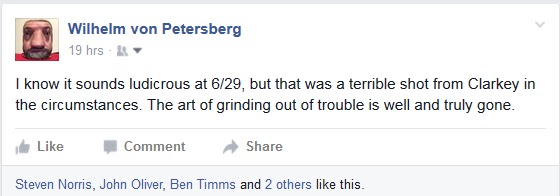


As Richie would say - "Australia... not an impossible task but pretty fuckin' close to it... !!"
Posted by The 12th Man on Thursday, 6 August 2015
Wednesday, August 5, 2015
How to Help Australia to Win the 4th Test

I must admit, I thought that by splashing out some money on England to win the 3rd Test, when they were being offered at ridiculous odds of $5.50, was a sure way to ensure victory for Australia. I was found to be incorrect in this case, but I won't lie that the extra cash windfall helped ease the pain slightly.
So how to help Australia in the all important 4th Test? Well, we really must win, we can't hope to draw and then win the 5th Test, so I need to take out both the option of England winning or salvaging a draw.
Thankfully the bookies are working for me in this instance, and so this is what I have done.
I have taken England at $3.40 to win the Test - $30 @ $3.40 = $102.00
I have also taken the draw at $3.75 - $20 @ $3.75 = $75.00
So for my $50 outlay, I will either:
- Take home $52 if England wins Test
- Take home $25 if it is a draw
- Lose $50 - but Australia win Test.
Perfectly logical...
Tuesday, August 4, 2015
Continued Inconsistency Plagues Ashes Cricket
It was a tough week to be an Australian cricket supporter. Everything had appeared so rosy after the Lords Test. Order had been restored. Australia had dominated a match on an unresponsive wicket, which meant that everything looked good heading into the final three Tests, and a retention of the Ashes. In eight sessions of cricket, this was blown away in a spate of poor batting, ordinary bowling and some poor fielding, and suddenly the Australians are so far behind the eight ball one wonders how they can possibly recover in time to reverse proceedings.
Whether or not the decision to bat first is seen to have been a mistake is irrelevant in the decisiveness of the loss. The conditions were not so untoward, given Cook suggested at the toss he would also have batted. The fact that Australia's batsmen were unable to make any more than 136 in that innings is where that match was lost. Australia's batting problems have been papered over for almost 12 months now, thanks to the amazing form of Steve Smith and Chris Rogers. Even at Lords, it was their partnership which ensured a huge total batting first, allowing the failures of Clarke, Voges and Mitch Marsh to pass almost unspoken of. At Edgbaston Smith failed twice for the first time in that 12 month period, and the middle order was exposed white bellied, and was gutted unmercifully. And then, even despite bowling poorly, the bowlers could have kept Australia in the match if they had been able to remove Broad or Ali early at 7/190. Instead, the 87 partnership put enough room between the two teams that when Australia's batting failed again it could not be recovered even through the tough work of Nevill and Starc.
So what happened? How did at team that was flogged by over 400 runs a week previous turn it around to win by the better part of seven wickets and over two days? Not to be unfair to England, but it was the Australians who brought it all upon themselves. England certainly improved, but not to the degree that the result suggests.
The truth of Australia's batting is now there for everyone to see, and the good news for England is that there is very little Australia can change to improve it. Take out Rogers' 52 from the first innings and Warner's 77 from the second innings, and ten Australian batsmen over those two innings contributed only 58 runs in total. It is a worrying trend. The swinging ball is again proving to be an insurmountable obstacle to Australia's batting, and precious few look likely to dig themselves in and fight their way through it. The dismissals of Voges and Marsh in particular reveal a technique raised on Western Australian wickets that is not sustainable in English conditions. Voges will be vulnerable in selection for the 4th Test given that the elder Marsh brother has scored a lot of runs in the county fixtures. The fact that they have been scored against substandard bowling attacks will not disguise the fact that he has form on the board, and Voges does not. If the change is made, it will not make Australian supporters feel any more secure, nor will it disappoint England's bowlers to have another left-hander to attack. Mitch Marsh's only replacement could be the recently deposed Shane Watson, but again that change would not really boost the confidence of Australians. No matter what the selection policy is in regards to an all rounders position in the Test line-up, you cannot bat at number 6 in Test cricket without scoring runs, and plenty of them. No ability to nip out wickets with the ball should replace the runs that are a prerequisite of batting in the top six of the Test team.
There seems to be an overreaction once again to an Australian captain who is a little short on runs. We saw it with Chappell, Border, Taylor, Waugh and Ponting. They all had a slump when they were approaching a zenith in their career, and all had their heads called for as a result. each and every one of them fought out of it, scored memorable innings to again prove their talent, and were able to (more or less) leave the game on their own terms rather than on the cry of the media wolves. And now its Michael Clarke's turn. His courageous century in Adelaide last year has been set aside, and the fact that it has been five Tests since then and he hasn't made a 'big' score. That's right, 5 Tests. Not to mention that he top scored in the World Cup final not that long ago. There's no doubt he doesn't look comfortable at the crease due to his well publicised injuries, and opposing bowlers know he has weaknesses because of this that they can target, which they do. And the dropped chance at slip off Ian Bell didn't look good. But seriously, who remembers the last one he grassed? And why does the media feel it must hound a player of Clarke's stature into retirement? If you would back anyone to succeed with his back to the wall, it would be Michael Clarke. His century in South Africa 16 months ago showed that. Clarke has more credits in the bank than just about anyone in Australian cricket. He deserves the leeway from the media and the public to fight his way back into form without his future being questioned at every turn.
What happened to Australia's bowling attack? All five were on fire at Lords and couldn't do a thing wrong. At Edgbaston they couldn't put the ball anywhere near the right areas. They were short, they were wide, they were too full. There was no pressure on the batsmen, and Bell and Root in particular were able to play as they liked. If these two hadn't both thrown their wickets away in the first innings it could have been an innings victory for England. The McGrath comparisons of Hazelwood at Lords dissipated at Edgbaston, his four wickets conceding runs at over 5 an over. Starc was wayward, almost back to his old ways of 18 months ago. Johnson bowled two cracking overs but couldn't back it up consistently. Lyon bowled with surprising penetrativeness without ever really looking as though he could bowl his way through the order. Were they underdone, as some speculated in the days that followed? Surely in this day and age that should not be allowed to occur. Did they take the break between Tests too easy? Did they just believe they had England's measure? None of that makes sense in a professional environment. It was obvious however that, whatever the reason, the Australians as a bowling group was as poor at Edgbaston as they were terrific at Lords.
Will there be changes? It appears highly unlikely. Peter Siddle has been advocated as a possible change to provide stability and accuracy, but at whose expense? And given Australia must now win at least one of the final 2 Tests - and probably both - to retain the Ashes - surely they need their most attacking bowlers in tow? What I wouldn't give to see Fawad Ahmed given an opportunity. It won't happen unless injury strikes Lyon, but seeing him against these English batsmen would be tantalising.
What the 4th Test will come down to is how much Australia want to fight back, and whether it can be done. England will be without Jimmy Anderson, but the possible return of Wood will make England feel comfortable. Their batsmen, Adam Lyth aside, will feel they have the Australians measure. If nothing else, this Test match should be the most competitive of the series so far, and hopefully the most watchable.
Whether or not the decision to bat first is seen to have been a mistake is irrelevant in the decisiveness of the loss. The conditions were not so untoward, given Cook suggested at the toss he would also have batted. The fact that Australia's batsmen were unable to make any more than 136 in that innings is where that match was lost. Australia's batting problems have been papered over for almost 12 months now, thanks to the amazing form of Steve Smith and Chris Rogers. Even at Lords, it was their partnership which ensured a huge total batting first, allowing the failures of Clarke, Voges and Mitch Marsh to pass almost unspoken of. At Edgbaston Smith failed twice for the first time in that 12 month period, and the middle order was exposed white bellied, and was gutted unmercifully. And then, even despite bowling poorly, the bowlers could have kept Australia in the match if they had been able to remove Broad or Ali early at 7/190. Instead, the 87 partnership put enough room between the two teams that when Australia's batting failed again it could not be recovered even through the tough work of Nevill and Starc.
So what happened? How did at team that was flogged by over 400 runs a week previous turn it around to win by the better part of seven wickets and over two days? Not to be unfair to England, but it was the Australians who brought it all upon themselves. England certainly improved, but not to the degree that the result suggests.
The truth of Australia's batting is now there for everyone to see, and the good news for England is that there is very little Australia can change to improve it. Take out Rogers' 52 from the first innings and Warner's 77 from the second innings, and ten Australian batsmen over those two innings contributed only 58 runs in total. It is a worrying trend. The swinging ball is again proving to be an insurmountable obstacle to Australia's batting, and precious few look likely to dig themselves in and fight their way through it. The dismissals of Voges and Marsh in particular reveal a technique raised on Western Australian wickets that is not sustainable in English conditions. Voges will be vulnerable in selection for the 4th Test given that the elder Marsh brother has scored a lot of runs in the county fixtures. The fact that they have been scored against substandard bowling attacks will not disguise the fact that he has form on the board, and Voges does not. If the change is made, it will not make Australian supporters feel any more secure, nor will it disappoint England's bowlers to have another left-hander to attack. Mitch Marsh's only replacement could be the recently deposed Shane Watson, but again that change would not really boost the confidence of Australians. No matter what the selection policy is in regards to an all rounders position in the Test line-up, you cannot bat at number 6 in Test cricket without scoring runs, and plenty of them. No ability to nip out wickets with the ball should replace the runs that are a prerequisite of batting in the top six of the Test team.
There seems to be an overreaction once again to an Australian captain who is a little short on runs. We saw it with Chappell, Border, Taylor, Waugh and Ponting. They all had a slump when they were approaching a zenith in their career, and all had their heads called for as a result. each and every one of them fought out of it, scored memorable innings to again prove their talent, and were able to (more or less) leave the game on their own terms rather than on the cry of the media wolves. And now its Michael Clarke's turn. His courageous century in Adelaide last year has been set aside, and the fact that it has been five Tests since then and he hasn't made a 'big' score. That's right, 5 Tests. Not to mention that he top scored in the World Cup final not that long ago. There's no doubt he doesn't look comfortable at the crease due to his well publicised injuries, and opposing bowlers know he has weaknesses because of this that they can target, which they do. And the dropped chance at slip off Ian Bell didn't look good. But seriously, who remembers the last one he grassed? And why does the media feel it must hound a player of Clarke's stature into retirement? If you would back anyone to succeed with his back to the wall, it would be Michael Clarke. His century in South Africa 16 months ago showed that. Clarke has more credits in the bank than just about anyone in Australian cricket. He deserves the leeway from the media and the public to fight his way back into form without his future being questioned at every turn.
What happened to Australia's bowling attack? All five were on fire at Lords and couldn't do a thing wrong. At Edgbaston they couldn't put the ball anywhere near the right areas. They were short, they were wide, they were too full. There was no pressure on the batsmen, and Bell and Root in particular were able to play as they liked. If these two hadn't both thrown their wickets away in the first innings it could have been an innings victory for England. The McGrath comparisons of Hazelwood at Lords dissipated at Edgbaston, his four wickets conceding runs at over 5 an over. Starc was wayward, almost back to his old ways of 18 months ago. Johnson bowled two cracking overs but couldn't back it up consistently. Lyon bowled with surprising penetrativeness without ever really looking as though he could bowl his way through the order. Were they underdone, as some speculated in the days that followed? Surely in this day and age that should not be allowed to occur. Did they take the break between Tests too easy? Did they just believe they had England's measure? None of that makes sense in a professional environment. It was obvious however that, whatever the reason, the Australians as a bowling group was as poor at Edgbaston as they were terrific at Lords.
Will there be changes? It appears highly unlikely. Peter Siddle has been advocated as a possible change to provide stability and accuracy, but at whose expense? And given Australia must now win at least one of the final 2 Tests - and probably both - to retain the Ashes - surely they need their most attacking bowlers in tow? What I wouldn't give to see Fawad Ahmed given an opportunity. It won't happen unless injury strikes Lyon, but seeing him against these English batsmen would be tantalising.
What the 4th Test will come down to is how much Australia want to fight back, and whether it can be done. England will be without Jimmy Anderson, but the possible return of Wood will make England feel comfortable. Their batsmen, Adam Lyth aside, will feel they have the Australians measure. If nothing else, this Test match should be the most competitive of the series so far, and hopefully the most watchable.
Tuesday, July 21, 2015
The Ashes: The (Aussie) Empire Strike Back
The startling turnaround in result from 1st Test to 2nd Test will no doubt be the result of jaw gnashing in both the England selectors room and for their supporters. Barely a week after they had completed a demolition job on Australia at Cardiff, with celebrations on a grand scale, as well as plenty of comments from the players in the media and from the media themselves, the tide has turned 180 degrees after England's shambolic performance at Lord's. Australia's calm response to their defeat, and England's frenzied obliteration has reopened wounds that the Poms would rather have seen untouched.
The benign flat wicket that was served up at Lord's was an obvious statement with the home team having gone 1-0 up - blunt Australia's bowlers, rack up big totals, and a high scoring draw leaves England in front in the series. Had England won the toss it would have been a ruse worth adhering to. Once Australia had won the toss and taken advantage of it with the bat, the pitch may have played its part in dullening Australia's pace trio, but their skill, perseverance and fitness was enough that it didn't matter, and they were able to dismantle the English batting line up despite the odds against them. The fact that this match lasted less than four days on this type of pitch is a major source of worry for the home team. Not just the fact that their own bowling line-up was completely ineffective due to the nature of the pitch, but that their batsmen were incapable of making a significant score on the same wicket.
Chris Rogers and Steve Smith both thumbed their noses at recent media speculation and again proved their worth at different ends of the spectrum of their careers. Rogers was flawless apart from the chance given to the slips cordon off the third ball of the match - oh how England must look back on that and moan. His value to this Australian team over the past two years must never be forgotten. He came in when the team has a revolving door of opening batsmen and was crying out for someone to be the anchor, and could get the team off to solid starts every innings. In this respect he has been almost flawless, and his fifth Test century was most fitting given his time as a Middlesex player was what earned him his Test recall five years after his lone Test match. When he retires after this series concludes he will be within days of his 38th birthday. Ultimately his Test career may be comparatively short, but the part he has played from turning around the rabble that finished in India in 2013 to now is as much his legacy as anyone else.
At the other end of the scale, Steve Smith continues to pile on the runs. The consistent diatribe from some of those in the England set up that they don't rate Steve's batting, and that his technique won't hold up under English conditions, is beginning to sound even more puerile the further into the series we go. His innings of 215 and 58 were only ended when he decided to chase faster runs in both innings, and gave up his wicket in doing so. If not for that, the England bowlers could well have still been out on that Lord's wicket, bowling to Smith on 1000 not out. As I posted elsewhere at one stage during the game, it's a good thing that the England bowlers have 'worked out' Steve Smith, as they claimed after the 1st Test - otherwise, just how many runs would he have gotten?
Australia's bowling was superb. Everything that was done wrong in Cardiff has been set to right by the bowlers and their coaching staff. What's more, all three pacemen were quick, noticeably quicker than their England counterparts, and this along with their lines and lengths showed that 20 wickets could be taken on a featherbed. Mitchell Johnson is fast redeeming himself from 2009, his aggression with the ball and not so much from his mouth has been superb. his spells visually shook up the batsmen, and even when he wasn't able to secure a wicket it was his spell that would gain one for the bowlers who came after him. Josh Hazelwood is becoming the bowler the selectors have hoped he would become over the past three years, and while Mitch Starc is hampered by injury he has still done a great job in support, especially in the early overs of the innings. Nathan Lyon again prised out wickets on an unresponsive pitch, and while he never looks a match winner he is at least earning his keep.
The two new boys did themselves proud. Mitch Marsh was a surprise inclusion in front of perennial under achiever Shane Watson, and did everything that could have been expected of him. A relative failure with the bat in the first innings was dwarfed by the three wickets he took in the match - top scorers Cook and Stokes in the first dig, and Ballance in the second. He then blasted Australia to the declaration in the second dig in the perfect riposte. More runs will be the key to his success, but if his bowling output is replicated like this every match no more can be asked of him in that regard. Peter Nevill swift elevation after the unavailability of Brad Haddin has proven to be one of the finest debut performances of a wicket keeper for Australia in memory. A brisk and calm 45 in the first innings, which was only terminated by the search for quick runs, showed poise and skill at the crease. behind the stumps however he was a revelation. Seven catches for the match, including a beauty up to Nathan Lyon, showcased his obvious talent, good footwork and neat glovework. What's more, the delight he showed through the game was refreshing. Even when he was denied a catch off Jos Buttler after being sent to the third umpire (a disgraceful decision that once again favoured the home team) he put it behind him and kept up his good work, culminating in the dismissal of Buttler off Lyon four overs later. A wonderful debut.
England was dreadful, and anyone who didn't see the 1st Test would be left wondering how on earth they won that match. Jimmy Anderson bowled terribly, off line and off length, little movement, and generally looked like a player well past his best. they fact he was so ineffective a week after looking the most dangerous of the English attack is a real concern for them, because they appear toothless without him. Even more concerning was the lack of anything from Mark Wood, who a few weeks ago was being hailed as the next genuine pace bowler for England. At Lord's his pace was mostly stuck in the mid 120kph, and with no movement of the ball in the air or off the wicket. Stuart Broad bowled some good spells in the first innings, and at least looked as though he was putting the batsmen under pressure. his tactics again came under question in the second innings, when he appeared to revert to time wasting and negative lines rather than try and prise out the batsmen at the crease. Moeen Ali was ineffective, with the wickets he took only coming from batsmen trying to up the ante. If he is England's best spin option then they are in serious trouble.
Their batting was completely shown up, and while that may have only been a blip for some, for others they may be approaching a dead end. Cook and Stokes were the best performed. Cook though, in order to prove one again he can be a force, has retreated so far into defensive mode that his strike rate is non-existent, and cannot dominate an attack. Stokes is playing with flair and abandon, but can't expect to continue to succeed if coming in at 4 for bugger all. Root was hollowed out cheaply in this Test, and his output for the remainder of the series will be interesting, to see if he can replicate his Cardiff form, if Australia now have his number again.
The rest of the batting line-up is under enormous pressure, and whether any are left by the end of the series will be a talking point. Lyth looks out of his depth. Ballance, as expected, has been summarily thought out by first the New Zealand attack and now the Australians. His technique is a shambles, and surely he hasn't got long to go before shaking hands with his County captain. Bell is a shadow of his best, and needs a score somewhere to secure his future. Buttler looks a T20 slogger and not up to playing a long match-saving innings when necessary. Ali has gone from opener to number 8, but won't get another ball in his half of the wicket this series after his dismissal on Sunday. The biggest problem they have is that there are no ready-made replacements putting their hand up in County cricket to replace the incumbents. Once again County cricket is being dominated by South Africans and Australians and all manner of washed out players from other countries who then appear like world beaters when they play in this competition.
The series lies at 1-1, and while it certainly isn't over for either team, the Australians will enjoy the break between Test more than the English. Barring any unforeseen injuries the only change for Australia will likely be Haddin to return for Nevill. England appears to be stuck with who they have, and can only hope that somehow the shattered batsmen and under performing bowlers can somehow pull themselves together in a week and rediscover what they need in order to compete in this series.
The benign flat wicket that was served up at Lord's was an obvious statement with the home team having gone 1-0 up - blunt Australia's bowlers, rack up big totals, and a high scoring draw leaves England in front in the series. Had England won the toss it would have been a ruse worth adhering to. Once Australia had won the toss and taken advantage of it with the bat, the pitch may have played its part in dullening Australia's pace trio, but their skill, perseverance and fitness was enough that it didn't matter, and they were able to dismantle the English batting line up despite the odds against them. The fact that this match lasted less than four days on this type of pitch is a major source of worry for the home team. Not just the fact that their own bowling line-up was completely ineffective due to the nature of the pitch, but that their batsmen were incapable of making a significant score on the same wicket.
Chris Rogers and Steve Smith both thumbed their noses at recent media speculation and again proved their worth at different ends of the spectrum of their careers. Rogers was flawless apart from the chance given to the slips cordon off the third ball of the match - oh how England must look back on that and moan. His value to this Australian team over the past two years must never be forgotten. He came in when the team has a revolving door of opening batsmen and was crying out for someone to be the anchor, and could get the team off to solid starts every innings. In this respect he has been almost flawless, and his fifth Test century was most fitting given his time as a Middlesex player was what earned him his Test recall five years after his lone Test match. When he retires after this series concludes he will be within days of his 38th birthday. Ultimately his Test career may be comparatively short, but the part he has played from turning around the rabble that finished in India in 2013 to now is as much his legacy as anyone else.
At the other end of the scale, Steve Smith continues to pile on the runs. The consistent diatribe from some of those in the England set up that they don't rate Steve's batting, and that his technique won't hold up under English conditions, is beginning to sound even more puerile the further into the series we go. His innings of 215 and 58 were only ended when he decided to chase faster runs in both innings, and gave up his wicket in doing so. If not for that, the England bowlers could well have still been out on that Lord's wicket, bowling to Smith on 1000 not out. As I posted elsewhere at one stage during the game, it's a good thing that the England bowlers have 'worked out' Steve Smith, as they claimed after the 1st Test - otherwise, just how many runs would he have gotten?
Australia's bowling was superb. Everything that was done wrong in Cardiff has been set to right by the bowlers and their coaching staff. What's more, all three pacemen were quick, noticeably quicker than their England counterparts, and this along with their lines and lengths showed that 20 wickets could be taken on a featherbed. Mitchell Johnson is fast redeeming himself from 2009, his aggression with the ball and not so much from his mouth has been superb. his spells visually shook up the batsmen, and even when he wasn't able to secure a wicket it was his spell that would gain one for the bowlers who came after him. Josh Hazelwood is becoming the bowler the selectors have hoped he would become over the past three years, and while Mitch Starc is hampered by injury he has still done a great job in support, especially in the early overs of the innings. Nathan Lyon again prised out wickets on an unresponsive pitch, and while he never looks a match winner he is at least earning his keep.
The two new boys did themselves proud. Mitch Marsh was a surprise inclusion in front of perennial under achiever Shane Watson, and did everything that could have been expected of him. A relative failure with the bat in the first innings was dwarfed by the three wickets he took in the match - top scorers Cook and Stokes in the first dig, and Ballance in the second. He then blasted Australia to the declaration in the second dig in the perfect riposte. More runs will be the key to his success, but if his bowling output is replicated like this every match no more can be asked of him in that regard. Peter Nevill swift elevation after the unavailability of Brad Haddin has proven to be one of the finest debut performances of a wicket keeper for Australia in memory. A brisk and calm 45 in the first innings, which was only terminated by the search for quick runs, showed poise and skill at the crease. behind the stumps however he was a revelation. Seven catches for the match, including a beauty up to Nathan Lyon, showcased his obvious talent, good footwork and neat glovework. What's more, the delight he showed through the game was refreshing. Even when he was denied a catch off Jos Buttler after being sent to the third umpire (a disgraceful decision that once again favoured the home team) he put it behind him and kept up his good work, culminating in the dismissal of Buttler off Lyon four overs later. A wonderful debut.
England was dreadful, and anyone who didn't see the 1st Test would be left wondering how on earth they won that match. Jimmy Anderson bowled terribly, off line and off length, little movement, and generally looked like a player well past his best. they fact he was so ineffective a week after looking the most dangerous of the English attack is a real concern for them, because they appear toothless without him. Even more concerning was the lack of anything from Mark Wood, who a few weeks ago was being hailed as the next genuine pace bowler for England. At Lord's his pace was mostly stuck in the mid 120kph, and with no movement of the ball in the air or off the wicket. Stuart Broad bowled some good spells in the first innings, and at least looked as though he was putting the batsmen under pressure. his tactics again came under question in the second innings, when he appeared to revert to time wasting and negative lines rather than try and prise out the batsmen at the crease. Moeen Ali was ineffective, with the wickets he took only coming from batsmen trying to up the ante. If he is England's best spin option then they are in serious trouble.
Their batting was completely shown up, and while that may have only been a blip for some, for others they may be approaching a dead end. Cook and Stokes were the best performed. Cook though, in order to prove one again he can be a force, has retreated so far into defensive mode that his strike rate is non-existent, and cannot dominate an attack. Stokes is playing with flair and abandon, but can't expect to continue to succeed if coming in at 4 for bugger all. Root was hollowed out cheaply in this Test, and his output for the remainder of the series will be interesting, to see if he can replicate his Cardiff form, if Australia now have his number again.
The rest of the batting line-up is under enormous pressure, and whether any are left by the end of the series will be a talking point. Lyth looks out of his depth. Ballance, as expected, has been summarily thought out by first the New Zealand attack and now the Australians. His technique is a shambles, and surely he hasn't got long to go before shaking hands with his County captain. Bell is a shadow of his best, and needs a score somewhere to secure his future. Buttler looks a T20 slogger and not up to playing a long match-saving innings when necessary. Ali has gone from opener to number 8, but won't get another ball in his half of the wicket this series after his dismissal on Sunday. The biggest problem they have is that there are no ready-made replacements putting their hand up in County cricket to replace the incumbents. Once again County cricket is being dominated by South Africans and Australians and all manner of washed out players from other countries who then appear like world beaters when they play in this competition.
The series lies at 1-1, and while it certainly isn't over for either team, the Australians will enjoy the break between Test more than the English. Barring any unforeseen injuries the only change for Australia will likely be Haddin to return for Nevill. England appears to be stuck with who they have, and can only hope that somehow the shattered batsmen and under performing bowlers can somehow pull themselves together in a week and rediscover what they need in order to compete in this series.
Thursday, July 16, 2015
Is This Finally The End?

Is it really the end? After all these years of mocking and taunting and anger and disbelief, and every other emotion one could describe... is this really the end?!
The boom fell mockingly during the World Cup when Shane Watson was dropped for Australia's match against Afghanistan in Perth when Rod Marsh was on duty, and no doubt after the selectors read my open letter that I sent to them. However, for the very next game, he had re-emerged thanks to Mark Waugh's take on the all-rounder position in the team, and despite getting worked over by Wahab Riaz in Adelaide in the quarter final (and if he had been held at fine leg early in that innings... well... maybe he would still not be here...) he remained in the team that eventually won the title. So his being dropped was a false dawn, and once again he was a part of the furniture. His returns in the two Tests in the West Indies were average, and despite being outplayed by Mitch Marsh in the two warm up games in England, he was chosen for the 1st Test which was completed in Cardiff last week.
So what has changed in a week? Watson's output in that 1st Test - 30 in the first innings (out LBW, referred, upheld, lose a referral) and 19 in the second innings (out LBW, referred, upheld, lose a referral) and 13 wicketless and impenetrative overs - is pretty much what he has dished up for the past two years, and apart from a few rare moments, for the most part of the past five years. This isn't a new phenomenon. In my angriest moments I have written about it in this blog here and here and here and here and here... and so on... and then there are the other fifty times where I just explode on social media. In essence, he put up the same figures last week as he has done for years, and now, almost suddenly, the selectors finally decide to drop him. It all makes perfect sense, because we've all thought it should have happened any number of times, but it also makes no sense at all. Why now? Why not in the West Indies? Why not against India at home, after he'd missed the Pakistan series with injury and Mitch Marsh had made such a good start there? Why not against South Africa? On and on, the opportunity to drop Watson has been available, on similar evidence. Why do it now, when not only has Australia lost the 1st Test when only Chris Rogers could have said to have succeeded well with the bat, but the team has lost the experience of Brad Haddin for the 2nd Test for family reasons? I'll be honest, as soon as Haddin's announcement was made, there didn't seem to be any way the selectors would lose any more 'experience', one of the final planks of Watson's resume that was often used as a reason NOT to drop him in the past.
The truth of the matter is that the Australians must believe that the English have Watson's number. They target that front pad, and are successful. They are not threatened by his bowling, and simply milk him around the field without any trouble. He can't field anywhere except first slip, and he is often saved there by Haddin's diving or Clarke's diving. Mitch Marsh may not do any better with either the bat or ball than Watson has in recent times, but the feeling is he certainly won't do worse. His form with the bat shows hope that he can succeed where Watson has not, and that his bowling is only there to hold up an end to give the four front liners a rest. If he takes wickets it's a bonus. He is also young in an exceptionally old team, and he will be enthusiastic. The reasons for keeping Watson in the team in front of anyone had grow tired and old and almost nonsensical. There was simply no reasons left, no matter how trivial, to keep him.
Is it really the end? Never say never. Losses at Lords and/or Edgbaston will open the door slightly for him, especially if Voges or Marsh cannot put a score on the board. Jason Voorhees and Michael Myers have been supposedly killed so many times they should be shredded mince meat, and yet they keep coming back and coming back. Shane Watson may not be a fictional movie villain, he may not have a mask, and he may wield willow rather than a cleaver, but I'll believe it's over when he announces he is joining Kevin Pietersen on his world tour of T20 domestic tournaments. Maybe then, and only then, we can rest easy.
Tuesday, July 14, 2015

Watson or Not, Australia Must Improve
England's victory in the 1st Test has seen the interest jump exponentially in the Old Dart, with visions of grandeur and regaining the old urn now firmly in their sights. Australia meanwhile is licking its wounds and cataloguing the cost of what was a disaster from lunchtime on the first day onwards.
The Australian bowlers just didn't bowl very well at times, and any plans they may have had for the batsmen appeared not to be followed. In Australia the bowlers bowled a full line on or about off stump to Joe Root to draw him forward without footwork. It wasn't always successful but it was more often than not. Root is certainly much improved since that series, but second ball he hit a ball just like that straight to the keeper - who dropped it. It proved to be a difference, numerically if nothing else. Even chasing 300 batting last on that wicket would have been almost impossible, and the start Root was given also protected the lower order from a relatively new ball. At 4/43 a score of over 400 was unlikely. The 87 runs the last three wickets put on was also a concern, though there was a certain amount of luck involved in that as well.
Australia's batting wasn't a loss either, but the method of dismissals probably was. Voges wafting twice outside his off stump, especially in the final moments of Day 2, was a concern. Watson as always, LBW in both innings. Haddin not the force at number seven as he was in 2013/14. Starts were made but not built on. That will happen, and will be rectified. The batsmen will not always succeed. But it was the fact that England's much maligned attack looked far more threatening, and swung the ball a hell of a lot more, than Australia's that will pose the most burning questions. With Ryan Harris now out of the equation, and the possibility of Mitchell Starc also being sidelined, suddenly Australia's attack looks a lot more threadbare and vulnerable than even a week ago. It can be a long time in cricket.
While England will now likely field an unchanged team in the coming matches and hope to cling to this lead, they will be acutely aware that they have had such a lead in their two recent Test series, before losing the advantage and finishing with a 1-1 score line. Questions remain over the top three in the batting line up, and given the conditions favoured their bowlers in Cardiff one wonders if they will do the same at Lords.
Australia's questions are many and varied, but given the recent history of team selections, the only one we are likely to see is Siddle in for Starc is he is unfit to play. Adam Voges will feel under pressure, more for the manner and timing of his dismissals in the 1st Test than anything to do with his form. He deserves an opportunity to rectify that, but as with anyone in his position, his age begins to nullify his chances fairly quickly at this stage of his career.
It is probably useless even bringing up Shane Watson's name at this point, given that no matter what he does or doesn't do, he just keeps being selected. 29 overnight at the start of day 3 and the chance to prove his worth, he was not only dismissed LBW for the addition of only one run, he also burned another referral in doing so. Then, in the second innings... yep, he did it all again. It must be galling and depressing for young cricketers around Australia to see him get so many chances without succeeding, knowing that they will either never get an opportunity at this level, or if they do they will never have as many opportunities to succeed if they put up similar numbers as Watson does. Mitch Marsh, or even Shaun Marsh, would be a better bet at six. No one can see it happening.
The series is now set up nicely, and we will be able to see if England can take on the front running role and win back the Ashes, or whether Australia can regroup and show the kind of form they have since this series two years ago.
The Australian bowlers just didn't bowl very well at times, and any plans they may have had for the batsmen appeared not to be followed. In Australia the bowlers bowled a full line on or about off stump to Joe Root to draw him forward without footwork. It wasn't always successful but it was more often than not. Root is certainly much improved since that series, but second ball he hit a ball just like that straight to the keeper - who dropped it. It proved to be a difference, numerically if nothing else. Even chasing 300 batting last on that wicket would have been almost impossible, and the start Root was given also protected the lower order from a relatively new ball. At 4/43 a score of over 400 was unlikely. The 87 runs the last three wickets put on was also a concern, though there was a certain amount of luck involved in that as well.
Australia's batting wasn't a loss either, but the method of dismissals probably was. Voges wafting twice outside his off stump, especially in the final moments of Day 2, was a concern. Watson as always, LBW in both innings. Haddin not the force at number seven as he was in 2013/14. Starts were made but not built on. That will happen, and will be rectified. The batsmen will not always succeed. But it was the fact that England's much maligned attack looked far more threatening, and swung the ball a hell of a lot more, than Australia's that will pose the most burning questions. With Ryan Harris now out of the equation, and the possibility of Mitchell Starc also being sidelined, suddenly Australia's attack looks a lot more threadbare and vulnerable than even a week ago. It can be a long time in cricket.
While England will now likely field an unchanged team in the coming matches and hope to cling to this lead, they will be acutely aware that they have had such a lead in their two recent Test series, before losing the advantage and finishing with a 1-1 score line. Questions remain over the top three in the batting line up, and given the conditions favoured their bowlers in Cardiff one wonders if they will do the same at Lords.
Australia's questions are many and varied, but given the recent history of team selections, the only one we are likely to see is Siddle in for Starc is he is unfit to play. Adam Voges will feel under pressure, more for the manner and timing of his dismissals in the 1st Test than anything to do with his form. He deserves an opportunity to rectify that, but as with anyone in his position, his age begins to nullify his chances fairly quickly at this stage of his career.
It is probably useless even bringing up Shane Watson's name at this point, given that no matter what he does or doesn't do, he just keeps being selected. 29 overnight at the start of day 3 and the chance to prove his worth, he was not only dismissed LBW for the addition of only one run, he also burned another referral in doing so. Then, in the second innings... yep, he did it all again. It must be galling and depressing for young cricketers around Australia to see him get so many chances without succeeding, knowing that they will either never get an opportunity at this level, or if they do they will never have as many opportunities to succeed if they put up similar numbers as Watson does. Mitch Marsh, or even Shaun Marsh, would be a better bet at six. No one can see it happening.
The series is now set up nicely, and we will be able to see if England can take on the front running role and win back the Ashes, or whether Australia can regroup and show the kind of form they have since this series two years ago.
Monday, June 22, 2015
Why England Are Favourites For the 2015 Ashes Series

Why England Are Favourites for the 2015 Ashes Series
It is just over two weeks until the Ashes series begins in England, for the third series in two years. It is an overkill to allow England the opportunity to prepare properly for the World Cup that took place earlier this year, without having to focus on An Ashes series before that tournament. as we have seen, that failed to help in any way their performance, and instead now has Australia defending the Ashes just 18 months after they reclaimed them from England, who had retained them just three months prior to that series in Australia. Still, much has changed since this time two years ago, when Australia arrived as a rabble after being thrashed by India in India and for the most part played like it, and England was ranked as the superior team and won as such without being able to assert complete dominance.
This time around though the tables have been turned just a fraction. England drew an entertaining two Test series against New Zealand, which probably asked more questions than it answered. Australia put the West Indies to the sword in their two Test series and arrive with options bulging for the 1st Test. Where two years ago Australia was forced to change their coach just before the Test series started and to suspend David Warner for his reckless behaviour, this time it is England who has changed its coach as well as still dealing with the Kevin Pietersen saga that has now stretched for over 12 months. Surely all of this points towards an Australian victory in the upcoming series.
Now, perhaps this will be seen as slightly controversial, or perhaps unpatriotic, but here are the reasons that England should be seen as favourites for this series, should all things be equal.
1. RECENT ASHES HISTORY IN ENGLAND
Australia won four straight Ashes series in England between 1989 and 2001, something quite unprecedented. But that was a team that was very special and England, while containing good players, at times appeared rudderless. Since then though, England has won the last three home Ashes series. In 2005 they broke Australia's 16 years Ashes stranglehold, though one wonders what may have happened had either Ricky Ponting chosen to bat first at Lords rather than bowl after Glenn McGrath was ruled out on the morning of the 2nd Test, or had Shane Warne caught Kevin Pietersen at first slip on the final morning of the 5th Test at The Oval when Australia pushed to bowl England out and give themselves a chase to draw the series. In 2009 Australia was unable to get the final wicket in the 1st Test to win that match, and having drawn level at Headingley went into The Oval dustbowl without a spinner, and suffered a series-losing defeat. In 2013 Australia was completely overwhelmed, and despite resistance in patches throughout, the 3-0 score line was a fair reflection on the series.
What this shows is that a status quo has been restored - England at home is now more formidable again than they necessarily are away from home. Beating them on their home turf is not a fait accompli.
2. THE SWINGING DUKE BALL
Australia's batsmen have shown weakness against a swinging ball before, and an impatience to see off the swing and build an innings beyond it. Jimmy Anderson and Stuart Broad may well seem to be not on their game at the moment, but you can be sure the new Australian coach will be insisting they pitch the ball up and swing it away from their opponents. Warner, Clarke and Watson are especially vulnerable to this attack, while Steve Smith's technique should be scrutinised by it. With no Graham Swann to call on, and despite the potency of Australia's own seam attack, one can only assume that there will be some bowler friendly wickets produced. If England manage to jag the better of the conditions as they seemed to against New Zealand they will be in a prime position to put enormous pressure on the Australian batsmen.
3. AUSTRALIA'S UNUSUAL PREPARATION
Two years ago Australia came almost straight from the dusty slow spinning wickets of India to England, where they then played the Champions Trophy before playing. It wasn't a great way to ready themselves for an Ashes series. This time Australia have played two Tests in the West Indies on unresponsive wickets, before heading straight to England for two warm up matches before the series begins. Once again, the preparation appears to be off kilter, though dispatching an ordinary Windies outfit could arguably be better than being thrashed by India. On the other hand, England was pushed to the limit by an excellent New Zealand side in the Tests, while the ODI series was also fought out the way that would please the England hierarchy. England has now seen how their probable team can react under pressure. Australia may well be still underdone following their World Cup triumph.
4. SHANE WATSON
Let's face it. The Australian selectors are never going to drop this guy, no matter what he does. He has too many get-out clauses. If he fails with the bat, he is too valuable as an "all rounder". If he fails with the ball, it's his batting that is his strength. If he fails with both, it is his "experience" that is necessary for the team. So we can expect another series where he averages in the twenties with the bat, takes one or to wickets at a cost of 200 runs, perches himself at first slip, and takes up a spot in the team that could go to someone who is more likely to contribute more to the cause, just because he is Shane Watson. Adam Voges would score more runs and do a better job as a part timer with the ball. Shaun Marsh would surely score at least as many runs. Mitch Marsh would definitely do no worse with both bat and ball. Hell, Josh Hazelwood, Mitch Starc and Mitch Johnson are all better bets as an all rounder at the moment! All Watson's continued selection does is bottle up a spot that could be utilised better and more efficiently. The Poms will be devastated if he is dropped.
5. MITCHELL JOHNSON
Yes, it's a different Mitch Johnson than we saw in 2009 and 2010/11. This one has won an Ashes almost on his own back (along with Brad Haddin) and he knows his place in the scheme of things now. But he was very ordinary in 2009, and he didn't play in the Tests in 2013, so how he performs in this series is still an open question mark. He was the leader of the pack 18 months ago, though now with Ryan Harris, Hazelwood and Starc at his side it's a shared responsibility. Still, his intimidation was the sealer then, and if that is not apparent during this series, it may well be that England are able to traverse the waters with more security. No doubt the Barmy Army will be giving it to him again like they did in 2009, and his reactions will be interesting.
6. UNSCARRED YOUNG GUNS
It could go either way depending on the initial exchanges, but England have four keys who have either not been scarred by defeat by Australia, or have had little scarring because of it. New opening batsman Adam Lyth, wicket-keeper Jos Buttler and fast bowler Mark Wood haven't played a Test against Australia, while the fearless Ben Stokes and number three bat Gary Ballance have had minimal contact. All five have shown a bit in recent times, though Ballance's frailties against New Zealand will be troubling to both him and the team. While this is not a given success for the summer, the fact that they do not carry any baggage from England's last Ashes series will be seen as a benefit for them and the team as a whole.
7. AUSTRALIAN COACHING TO THE RESCUE
The shambles that has been the top level of English cricket for the last two years has, for the moment, been put to rest. The appointment of Andrew Strauss as cricket supremo is being hailed as a wonderful appointment. His first decision in ruling out any chance of Kevin Pietersen returning to the side was a complete ballsup. However, it is likely that there will be less panicking and more solidity at the top with Strauss in the job. More importantly, the appointment of Trevor Bayliss will no doubt be a success over time, but is immensely important immediately, with his knowledge of the Australian cricket set up and players, having been closely involved with them for some time. If there are any secrets to be known, he will know them, and this can only be of benefit to England in this series.
There are any number of reasons to refute the claims made above (1. History means nothing, 2. Aussies will swing ball just as much against just as fallible batsmen, 3. Australia won in Windies, England struggled to draw in Tests and barely won ODI's, 4. We've won with Watson in the team before, 5. Super Mitch is mentally tough now, Barmy Army are fat noisy idiots, 6. Those five haven't played against a decent team yet, 7. All the knowledge in the world won't help if they don't have plans and they don't execute them), but in the long run, home ground advantage and home crowds should bring these two sides a lot closer together than the last time they met. Thus England should be awarded favouritism for the series, and Australians should be wary.
(NB. Is this all a furphy, a way to try and trick the cricketing gods into believing this is what I think, and thus tip the glory Australia's way? Of course it is! And the fact I will also have $100 on England to win the series at the current $5.00 should be enough to ensure Australia passage to victory).
Subscribe to:
Posts (Atom)